One of my childhood memories begins with my grandmother and earth.
I remember my grandmother heating earth over a fire, then soaking it in water and giving it to me when I had a fever.
I cannot now identify the earth she used or the place it came from. The memory remains incomplete. It records something that happened in my family, and it has prompted a question: where does an experience like this sit within the older beliefs of Isan?
A practice with a name
Eating earth is often described as geophagy. In Thailand, it appears in cultural accounts that bring together everyday practice, medicinal belief and stories about the relationship between people and the land.
A 2022 study by Mahidol University scholar Aphilak Kasempholkoon, Soil as Food: From the Myth of Nguan Din to Soil as Food in Thai Culture, examines documents and scriptures. It records beliefs and practices; it does not establish a clinical benefit from eating soil.1
What the Isan record describes
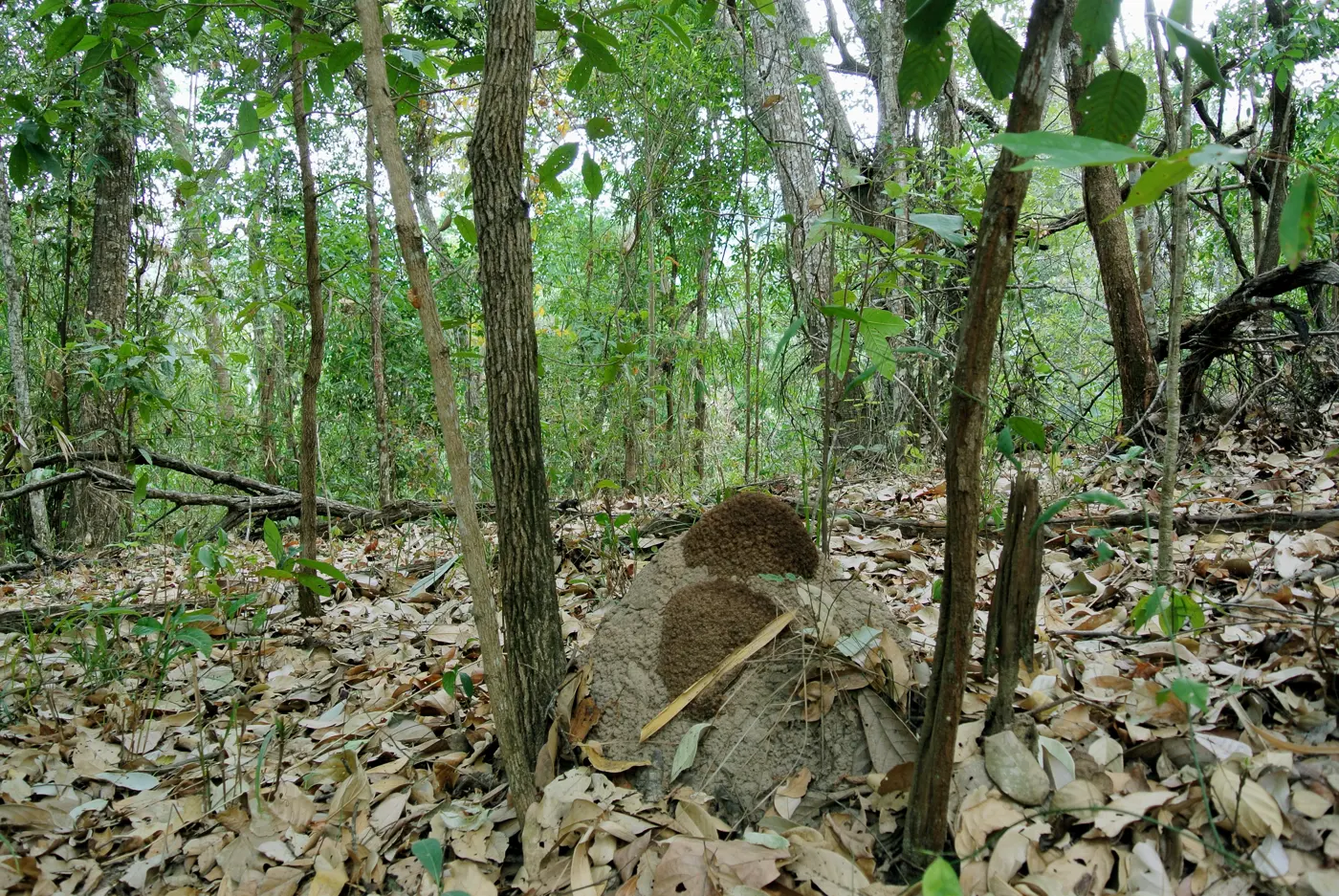
Among its examples is din phon (ดินโพน), earth associated with Isan. The account describes clay taken from mound-like formations and records beliefs about its appealing smell and use for abdominal discomfort or morning sickness. These are reported historical beliefs. They do not establish a remedy for fever, or identify the earth in my memory.1
The distinction matters because a resemblance between two accounts can invite a conclusion too quickly. My grandmother’s practice may share features with the documented tradition, but I cannot supply the missing name or provenance. Leaving that question open is part of telling the story accurately.
Why “black earth” needs a careful description
“Black earth” is not a sufficient identification. The same study discusses dark and light termite-mound earth in a section on traditional Thai medicinal materials. That wider discussion should not be treated as proof of a single Isan custom, or as confirmation that my family used one of those materials.1
For a future oral-history interview, the useful details would be the local word, the source of the earth and the occasion on which it was given. Where those details have been forgotten, a family recollection should retain its limits.
Belief, story and evidence
The study also considers nguan din (ง้วนดิน) within Buddhist cosmological narratives. Such material belongs to the history of belief and storytelling. A sacred account and a remembered household practice are different kinds of evidence, and neither by itself proves a medical effect.1
What modern health guidance adds
Soil can contain substances that are harmful when swallowed. MedlinePlus, a service of the US National Library of Medicine, lists possible contaminants including pesticides, fertilisers, parasites, bacterial toxins and human or animal waste. It also notes that swallowing dirt can cause constipation or intestinal blockage.2
There is a relevant documented example from Thailand. In 2019, the Department of Medical Sciences reported tests of water and mud from springs in Nakhon Ratchasima. Samples failed chemical or microbiological quality criteria, and the department advised against drinking the spring water or using the mud on the body. Those findings concern that location; they do not tell us what was in the earth my grandmother used.3
Keeping a memory without filling its gaps
What I can offer is the recollection itself: a grandmother, a childhood fever and a practice whose explanation I can no longer fully recover. I do not know whether it changed the course of my illness.
That uncertainty does not remove the memory’s place in a family story. It gives the story a responsibility: to preserve what is remembered, acknowledge what is missing and let cultural history and present-day health knowledge speak clearly alongside it.
Explore more Food & Culture
Sources & further reading
- Aphilak Kasempholkoon — Soil as Food: From the Myth of Nguan Din to Soil as Food in Thai Culture, Mekong-Salween Civilization Studies Journal 13(2), 201–226 (2022), especially pp. 215–217
- MedlinePlus / US National Library of Medicine — Dirt: swallowing
- Thailand Department of Medical Sciences — March 2019 newsletter: laboratory findings from mud springs in Nakhon Ratchasima, pp. 12–13
Sources checked 8 November 2026. Historical findings are identified by date. Cultural interpretations are the author’s; this article does not report new field interviews. The personal memory is the author’s own account, translated from Thai.