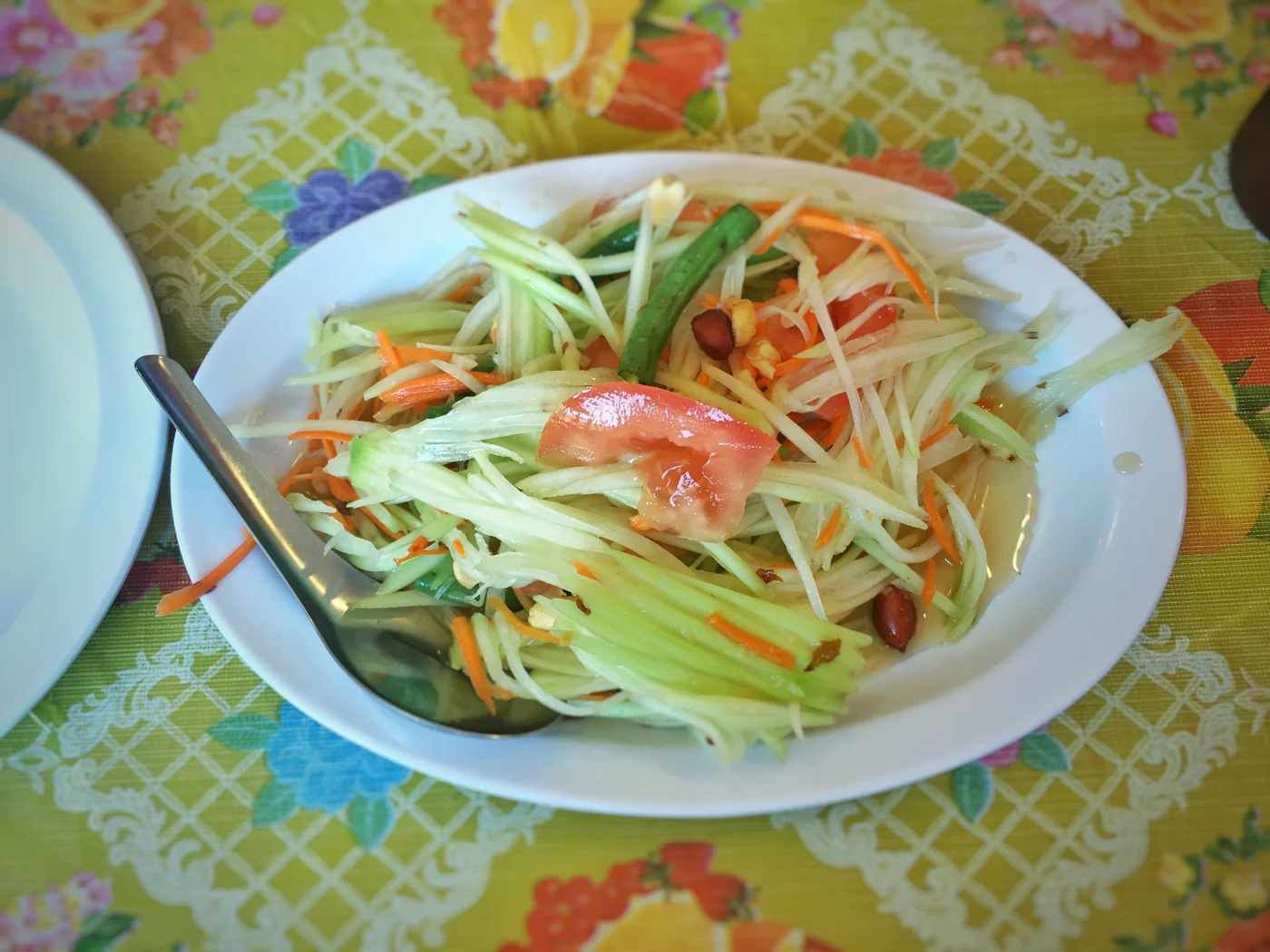
First comes the invitation to taste. A little papaya, a trace of lime, the warmth of chilli that arrives a moment later. Then comes the more interesting question: how would you like the next mouthful?
For a visitor, som tam can seem like a dish to identify and tick off a list. A more rewarding approach is to treat it as an introduction. Its flavours offer something to talk about; its place among other dishes offers a reason to share. In this story, the salad is our starting point. The table is the destination.
A place in the Isan meal
Som tam belongs firmly in the food landscape of Northeast Thailand, known as Isan. Thailand Foundation places it alongside laab and grilled chicken among the region’s familiar dishes, with sticky rice as the staple. The same account emphasises that Isan and neighbouring Laos share many culinary traditions.2
That regional context matters. Isan food cannot be understood through chilli alone. Sourness and saltiness are central too, and pla ra—fermented fish—contributes a distinctive savoury depth. These flavours belong to a wider food culture, rather than to a single recipe that every household must follow.2
What does “tam” actually mean?
Tam (ตำ) is a verb: to pound with a pestle. In the kitchen, the khrok, or mortar, holds the ingredients while the sak, or pestle, works them together. The word names an action, rather than one particular vegetable.9
That distinction unlocks an entire menu. A Southern Isan research synthesis records tam taeng, made with cucumber, and tam thua, with long beans, alongside versions using other local produce. Papaya is one possibility within a much broader way of preparing food.6
In som tam, pounding and mixing belong together: the embassy demonstration shows the seasoning being worked in the mortar before the vegetables are combined. Think of the technique as bringing flavour into contact with texture, rather than reducing everything to a paste.4
The craft inside the mortar
The familiar green-papaya version begins with unripe fruit, whose pale shreds provide texture rather than the sweetness of ripe papaya. Thailand’s Department of Agricultural Extension lists tomatoes, long beans, garlic and chillies among its ingredients, with palm sugar, tamarind, lime and fish sauce shaping the seasoning. Peanuts and carrot appear in its version too.3
Preparation is a small exercise in transformation. In the Royal Thai Embassy in Ottawa’s demonstration, aromatics are pounded, the seasoning is worked together, then the vegetables and other ingredients are mixed in and the taste adjusted. What reaches the plate has been brought together through touch as much as measurement.4
One name, many possibilities
There is no single, settled origin story. The MICHELIN Guide discusses competing historical accounts and describes a broader Isan tradition of pounding sour produce. Papaya is the best-known ingredient, but the family of dishes extends beyond it.1
Tam Thai
Typically includes peanuts and dried shrimp.
Tam Lao / Tam Pla Ra
Features fermented fish, with its pronounced savoury character.
Tam Pu
Includes salted or pickled crab.
Tam Pu Pla Ra
Brings crab and fermented fish together.
A short guide, not fixed formulas: names and recipes vary between cooks.1
Beyond the familiar: pa, mua, sua and laek
Some names describe a recognisable addition; others leave more room for a cook’s interpretation. These distinctions help a visitor explore without expecting every restaurant to serve an identical dish.
Tam Pa (ตำป่า): a generous mix
Often translated as “jungle-style” som tam, tam pa brings a fuller collection of ingredients into the bowl. A Southern Isan research synthesis records shellfish, pickled bamboo shoots and fresh vegetables in this style. The name should not be read as a guarantee that its ingredients were gathered from a forest.6
Tam Mua (ตำมั่ว): many things together
Tam mua is a mixed version rather than a precise shopping list. The same research records pickled greens, long beans, bean sprouts, khanom chin rice noodles and pork crackling among its additions. It can overlap with tam pa: ask what is in this particular cook’s mixture.6
Tam Sua (ตำซั่ว): the noodle connection
The defining addition is khanom chin: thin rice noodles mixed through the som tam. Thailand’s Department of Cultural Promotion describes this combination explicitly. Soft noodles introduce a different texture beside the crisp papaya and carry the dressing into each forkful.7
Tam Laek (ตำแหลก): read the name with curiosity
Laek means broken or crushed into small pieces; paired with tam, the words evoke thorough pounding. Yet “Tam Laek” also appears as a restaurant name—for example, in Go Ayutthaya’s restaurant directory. The name alone does not establish a standard regional recipe or a fixed set of ingredients. If it appears on a menu, ask the cook what their version contains.10, 8
The pleasure of eating together
In interviews with the MICHELIN Guide, restaurateurs describe som tam as particularly enjoyable in company. Sticky rice takes up the dressing; grilled and fried dishes provide complementary flavours and textures. A meal can move between crisp papaya, warm rice and a bite from another shared plate.1
For an international reader, this is a useful change of perspective. Instead of looking for one perfect plate to keep to yourself, consider what the whole table might enjoy. You can compare preferences without needing to agree. One person’s favourite is an invitation to taste, rather than a test of who can tolerate the most heat.
An everyday dish, made personal
Thailand’s Government Public Relations Department notes that som tam varies considerably in sweetness and spiciness, and that many stalls and restaurants let diners adjust ingredients to taste. Personal preference is part of the experience, not an interruption to it.5
In Khon Kaen, a useful way to begin is to ask what a cook recommends, then explain what you enjoy. Start with a manageable amount of chilli. Ask about fermented fish, crab or dried shrimp rather than relying on the English word “salad” to tell you everything. The ingredient lists above show why a vegetable-led dish may still contain fish, shellfish or peanuts.
For readers with dietary requirements, discussing the ingredients is more useful than choosing by appearance. For everyone else, it is simply good curiosity: what gives this version its particular character?
A taste of belonging
In this series, sticky rice offers a way into daily life, and laab opens a conversation about flavour and cultural meaning. Som tam adds the pleasure of difference: between recipes, between preferences, and between the people gathered to eat.
To call it a spicy salad tells a visitor what might be on the plate. To share it offers a glimpse of something more. A meal becomes a meeting place—and the next mouthful gives you a reason to linger.
Sources & further reading
- MICHELIN Guide — Decoding Som Tam, Thailand’s Delicious Papaya Salad
- Thailand Foundation — Northeast Thai Cuisine
- Department of Agricultural Extension — Som Tum
- Royal Thai Embassy, Ottawa — Cook Along, Episode 2: Som Tum + Gai Yang
- Government Public Relations Department — Som Tam and Phla Kung (25 April 2023)
- Sutheera Khemthong — Southern Isan som tam research synthesis, Nakhon Ratchasima Rajabhat University (completed 2007)
- Department of Cultural Promotion — Som Tam
- Go Ayutthaya — Tam Laek restaurant profile
- Longdo Dictionary — ตำ, including Royal Institute and LEXiTRON entries
- Longdo Dictionary — แหลก, including Royal Institute and LEXiTRON entries
Sources checked 8 November 2026. Regional customs and recipes vary. Cultural reflections in this article are editorial interpretation, not a reported interview.